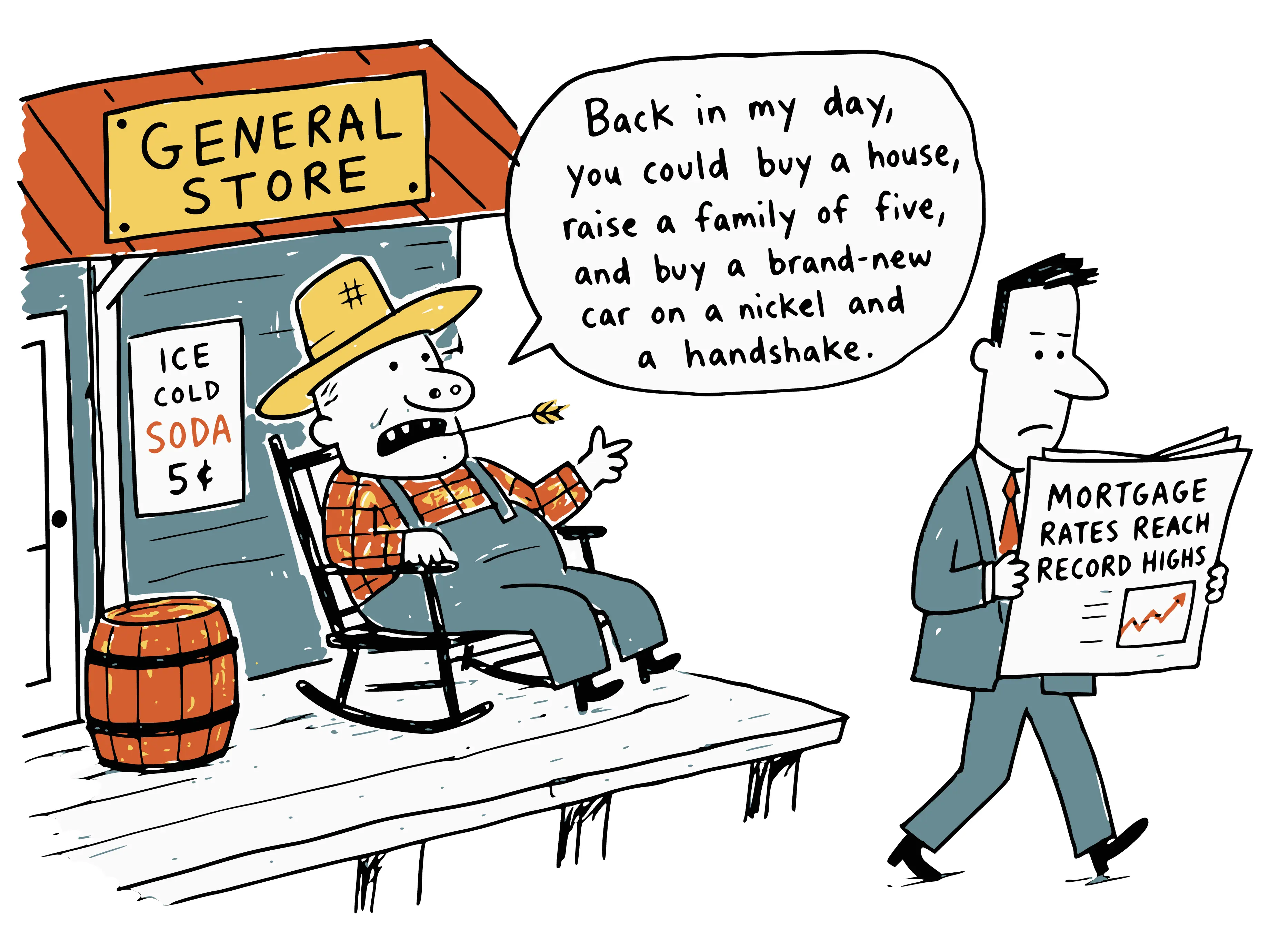
HomeServices of America, the company that owns the Berkshire Hathaway HomeServices network I hang my license with, published a white paper on July 16 arguing that the housing industry is worried about the wrong crisis. The gist: sellers are thriving on record equity, and the people actually being priced out are the buyers who have not entered the market yet, whose numbers are quietly collapsing. I read The Real American Housing Crisis: What's Happening to Our Future Homeowners?, then went back to my own June numbers and read it again. It's worth your time.
What the white paper found
The paper was written by Chris Kelly, president and chief executive of HomeServices of America, and it pulls from Gallup, the Federal Reserve, the U.S. Census Bureau, NAR and Realtor.com.
Its starting point is a Gallup finding that nearly nine in ten Americans now say buying a home is harder than ever. The number underneath that comes from the 2026 Gallup Economy and Personal Finance poll. Among non-homeowners, the share who expect to buy within five years is 19 percent, a record low. Between 2013 and 2018 that figure ran between 41 percent and 49 percent. Among non-homeowners aged 18 to 34, it has gone from 57 percent in the 2013 to 2015 period to 29 percent in the combined 2025 to 2026 average. First-time buyers now make up only about 21 percent of all buyers, against a historical norm closer to 40 percent.
Now set that against the owner side. Federal Reserve data puts total U.S. homeowner equity at $35 trillion, an all-time high. The typical mortgage-holding homeowner carries about $302,000 in equity, national home values have appreciated roughly 75 percent to 90 percent over the past decade, and Bankrate counts nearly half of all mortgaged homes, 46.2 percent, as "equity-rich." Per NAR, baby boomers alone account for 55 percent of sellers and 42 percent of buyers, moving through the market with a flexibility that first-time buyers simply do not have.
Kelly's argument is that much of the industry conversation right now centers on days on market, price adjustments and listing visibility, all of which are framed around that seller population, which by nearly every financial measure is fine. His analogy is that it is like talking to one group about water safety while ignoring the people who may be drowning in the pool. He makes the case that the more consequential long-term problem sits with the people who have not entered the market yet at all.
How that reads against June in Northwest Philadelphia
Here are the June Bright MLS figures again:
- Roxborough: $400,000 median, 2.8 months of supply
- East Falls: $379,000 median, 2.8 months of supply
- Manayunk: $418,950 median, 2.8 months of supply
- Mt. Airy: $515,000 median, 4.5 months of supply
- Chestnut Hill: $775,000 median, 5.8 months of supply
The three neighborhoods with our lowest medians also had our lowest months of supply. The two highest-priced ones had the most inventory. Redfin put the national median sale price at $408,814 in June, and Roxborough and Manayunk both closed within about $20,000 of that. The most attainable corners of Northwest Philly are also the tightest, which is exactly where a first-time buyer feels the squeeze.
The white paper points at why. Owners who locked 30-year mortgages between 2.5 percent and 4 percent during 2020 to 2022 hold a cost-of-carry advantage of $800 to $1,200 a month over the same debt at today's rates. Freddie Mac had the 30-year fixed at 6.49 percent on June 25. That gap is a direct contributor to how little resale inventory those first three neighborhoods carry: the owners who would normally sell a starter home and move up are staying put, because giving up a 3 percent mortgage is expensive. It also tilts the field toward buyers who are not borrowing at all, which is a big part of why cash and financed offers don't compete on equal footing.
The down payment is its own mountain. The paper cites NAR data putting the average time to save one at close to 10 years. If you are renting here and working toward that, the closing costs a Northwest Philadelphia buyer actually pays are worth knowing early, because they change the real number you are saving toward.
The part about waiting
The Realtor.com 2026 Generational Wealth and Housing Report found that buying before age 30 is linked to a 22.5 percent higher net worth by age 50 compared to renting. The benefit is not linear, and it fades fast. Delay to the late 30s and it is cut in half. Delay past 43 and it disappears. The uncomfortable detail is that the median first-time buyer is now roughly 40 years old, which lands the typical first-timer right at the edge of the window where the advantage fades.
"Earlier entry into the market doesn't just provide a place to live; it catalyzes broader balance-sheet growth," Realtor.com chief economist Danielle Hale is quoted as saying. Early buyers get more years of appreciation and forced savings through mortgage paydown, and that compounds into everything that comes after it.
Two more findings from that report stayed with me. Parental wealth transfers now explain roughly 13 percentage points of the homeownership rate among young households, and adults raised in homeowner households are about 18.4 percent more likely to own a home by age 35. Homeownership is increasingly a function of family wealth, not just personal discipline. And per Census Housing Vacancy Survey data from Q4 2025, homeownership sits at 75.1 percent for white households, 48.7 percent for Hispanic households and 44.2 percent for Black households, a gap wider than it was in 1968 when the Fair Housing Act passed.
The part aimed at my own industry
There is one more thread in the paper I do not want to skip, because it is pointed squarely at my own side of the business. Kelly argues that efforts to limit housing information, inventory visibility and pricing transparency, all of them meant to protect short-term seller leverage, may end up weakening the very pipeline of future buyers the industry depends on. In his words, an industry that prioritizes short-term positioning over long-term access is "consuming its own future."
I agree with him, and it is part of why I write these posts the way I do. When I lay out how accurate a Zestimate really is, or what actually happens when you click "contact agent" on Zillow, the goal is the same one Kelly is describing: a buyer who understands the market makes better decisions, and keeping people in the dark does not serve anyone for very long.
The paper closes by calling for more attention and resources aimed at affordability, access, inventory and transparent pathways to ownership. I would add one local note. A 19 percent national figure tells you nothing about whether the math works on your block, and $400,000 in Roxborough is a different question than $400,000 almost anywhere else.
So if you are renting in Northwest Philly and you have been assuming the door is closed, let's actually run the math. Bring me your numbers, I will bring the comparables for the street you want to live on, and we can walk through what an offer would really look like for your situation rather than a national average.
Henry is a Philadelphia-based REALTOR® serving buyers and sellers in Northwest Philadelphia and Montgomery County, PA. Questions? Get in touch.
Based on information from Bright MLS for 6/1/2026 through 6/30/2026; data is reliable but not guaranteed.
Frequently asked questions
What does the HomeServices of America housing white paper say?
The paper, 'The Real American Housing Crisis: What's Happening to Our Future Homeowners?', argues the industry is worried about the wrong crisis. Sellers hold about $35 trillion in home equity and are doing fine by nearly every financial measure, while the share of non-homeowners who expect to buy within five years has fallen to 19 percent in 2026, a record low, down from a range of 41 percent to 49 percent between 2013 and 2018. Its conclusion is that the more urgent long-term problem is the next generation of buyers who have not entered the market at all.
How many people expect to buy a home in the next five years?
According to the 2026 Gallup Economy and Personal Finance poll cited in the white paper, just 19 percent of non-homeowners expect to buy within five years, a record low compared with 41 percent to 49 percent between 2013 and 2018. Among non-homeowners aged 18 to 34, the historic driver of first-time buying, the figure fell from 57 percent in the 2013 to 2015 period to 29 percent in the combined 2025 to 2026 average.
Does buying a home earlier actually build more wealth?
The Realtor.com 2026 Generational Wealth and Housing Report cited in the paper found that buying a home before age 30 is linked to a 22.5 percent higher net worth by age 50 compared with renting. That advantage is roughly cut in half by the late 30s and disappears after age 43. Because the median first-time buyer is now about 40 years old, the typical first-timer is buying right at the edge of the window where the wealth benefit fades.
Can first-time buyers still afford Northwest Philadelphia?
It is tight but not closed. In June 2026, Roxborough closed at a $400,000 median, East Falls at $379,000 and Manayunk at $418,950, all within roughly $20,000 of the $408,814 national median, but each carried only about 2.8 months of supply. Mt. Airy ran $515,000 and Chestnut Hill $775,000 with more inventory. Whether the math works depends on your specific numbers for the street you want, which is worth running before you assume you are priced out.