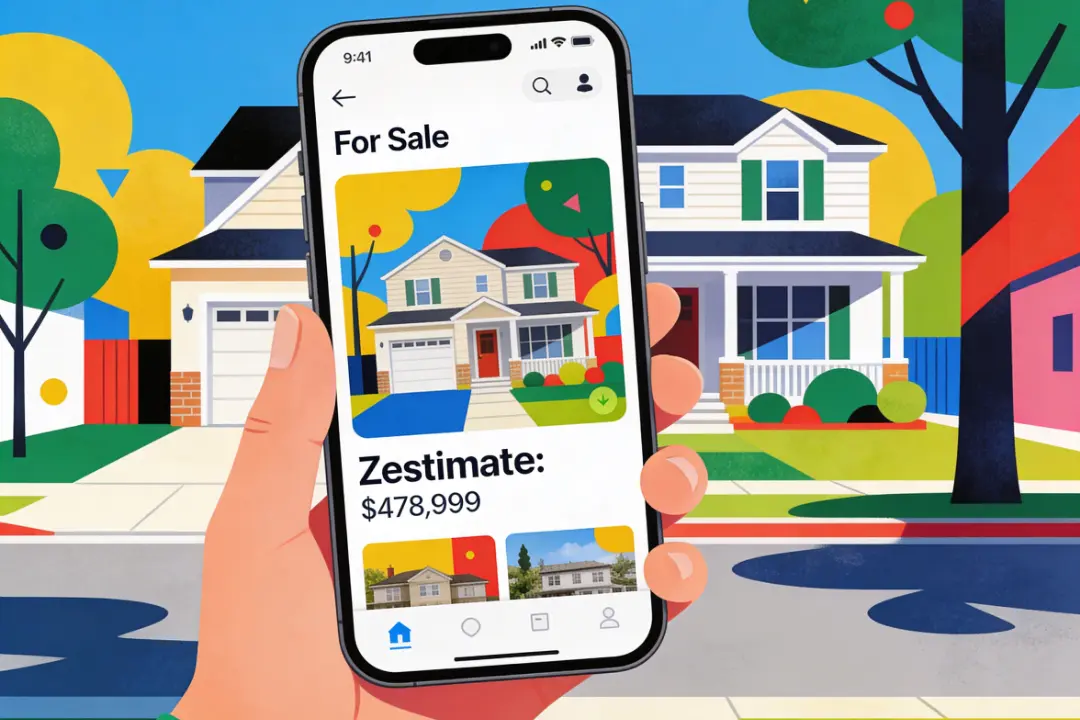
Most people who have spent any time on Zillow have seen a Zestimate. It sits right at the top of every listing, next to the address and the photo count. For a lot of buyers and homeowners, it's the first number they associate with a home's value. What it actually represents is worth understanding before you put much weight on it.
What Zillow Says a Zestimate Is
Zillow describes the Zestimate as an estimate of a home's market value, not an appraisal. It cannot be used in place of an appraisal, and Zillow says as much directly on its Zestimate page.
The number is generated by a neural network model that pulls from multiple data sources: county and tax assessor records, direct feeds from hundreds of multiple listing services and brokerages, and user-submitted data. According to Zillow, the model incorporates home characteristics like square footage, bedroom and bathroom count, and location; on-market data including listing price, comparable homes, and days on market; off-market data from tax assessments and prior sales; and market trends including seasonal shifts in demand.
Zillow publishes Zestimates for 118 million homes across the country. The model updates multiple times per week.
On-Market vs. Off-Market: Two Very Different Numbers
This is where most people get tripped up, and it's the most important distinction Zillow makes about its own accuracy.
When a home is listed for sale, the Zestimate gets a significant advantage: it can incorporate the listing price, the listing description, and data about comparable active and recently sold homes. That additional signal makes the estimate considerably more precise.
For homes that are not on the market, the model has no listing data to work with. It relies entirely on public records, tax assessments, prior sales, and whatever home facts have been submitted or are on file. Public records are often incomplete, delayed, or missing significant updates like a finished basement, an added bathroom, or a kitchen renovation.
Zillow's own accuracy data, last refreshed July 14, 2026, highlights the gap.
Nationally: - On-market homes: median error rate of 1.77% - Off-market homes: median error rate of 7.21%
At a national level, nearly 96% of on-market homes have a Zestimate within 10% of the final sale price. For off-market homes, only about 62% fall within 10%.
What the Numbers Look Like for Philadelphia and Pennsylvania
The national figures are one thing. The Philadelphia metro and Pennsylvania specifically tell a different story. Zillow's own published accuracy data, side by side:
| Median error | Within 5% of sale price | Within 10% of sale price | |
|---|---|---|---|
| Philadelphia metro, on-market | 2.12% | 81.00% | 95.15% |
| Philadelphia metro, off-market | 7.76% | 35.19% | 59.49% |
| Pennsylvania, on-market | 2.14% | 79.91% | 94.95% |
| Pennsylvania, off-market | 9.12% | 30.98% | 53.29% |
| National, on-market | 1.77% | 84.82% | 95.79% |
| National, off-market | 7.21% | 37.68% | 61.76% |
Read the off-market rows carefully, because that's the number most homeowners are looking at. For homes sitting off-market in the Philadelphia area, Zestimates land within 10% of the actual sale price only about 59% of the time. Four in ten off-market Philadelphia homes have a Zestimate that misses the eventual sale price by more than 10%. Statewide it's worse: only about half of off-market Pennsylvania Zestimates land within 10%.
To put that in dollars: on a $500,000 Mt. Airy twin, a 10% miss is $50,000. The median off-market error of 7.76% is still roughly $39,000, in either direction. At that scale, it's the difference between pricing a listing correctly and chasing the market down for two months.
How the Redfin Estimate Compares
Zillow isn't the only automated valuation on your home. Redfin publishes its own number, the Redfin Estimate, for about 130 million homes, and it discloses accuracy figures the same way Zillow does.
As of Redfin's data last updated July 24, 2026:
| Zestimate (national) | Redfin Estimate (national) | |
|---|---|---|
| On-market median error | 1.77% | 1.85% |
| Off-market median error | 7.21% | 7.26% |
| Homes covered | 118 million | 130 million |
| Update frequency | Multiple times per week | Daily on-market, weekly off-market |
Two things stand out. First, the models are effectively tied: neither has a meaningful accuracy edge nationally. Second, and more importantly, they share the same failure mode: both are roughly 4x less accurate the moment a home isn't listed, because both lean on the same incomplete public records when there's no listing data to anchor them.
This is also why the two numbers often disagree with each other. If Zillow says $480,000 and Redfin says $445,000, that $35,000 spread says less about the models than about the home: the underlying data on it is thin, and each model is filling the gap differently. A wide Zestimate-to-Redfin spread is actually a useful tell: it usually means the public record on the home is incomplete, which in Northwest Philadelphia is common.
Why Off-Market Accuracy Is Lower in Older, Denser Markets
Zillow notes that accuracy is directly tied to the amount of data available for a home and its surrounding area. That dependency matters a lot in a market like Northwest Philadelphia.
Homes in Mt. Airy, Chestnut Hill, Germantown, and the surrounding neighborhoods tend to be older stock with varied histories. A rowhome might have been subdivided and recombined. A Victorian twin might have had a third floor added decades ago that never made it into county records accurately. A home might have a finished carriage house or a significant renovation that never triggered a reassessment. None of that shows up in a Zestimate unless it was reported and recorded.
Beyond missing records, there's a category of things no algorithm can see because they were never in any database to begin with. In this housing stock specifically:
- Condition of the big-ticket systems. Two stone twins on the same block can carry identical public records while one has a new slate roof, updated electrical, and repointed masonry, and the other still has knob-and-tube wiring and a 90-year-old roof. That's easily an $80,000–$150,000 difference the model has no way to price.
- Which side of the renovation cycle a home is on. Much of this area's stock was built between 1880 and 1940. The market here prices "tastefully updated, character intact" very differently from "renovated in 1987," and differently again from "flipped last year with the original details ripped out." All three look the same in tax records.
- Block-by-block variation. The model works on location signals that are coarser than the reality on the ground. A house across from the Wissahickon trailhead and a house three blocks away backing onto a commercial corridor can be treated as near-neighbors by an algorithm and priced very differently by actual buyers.
- The lot. Deep lots, side yards, parking, and outbuildings are inconsistently recorded in Philadelphia public data, and they're often exactly what a buyer is paying a premium for in East Falls or Wyndmoor.
Zillow acknowledges the underlying issue directly: if home data is incorrect or incomplete, the Zestimate may not reflect reality. Homeowners can update their home facts on Zillow, and Zillow encourages reporting updates to the local tax assessor so those changes are reflected in public records.
What Happens When a Home Goes On the Market
Zillow addresses this specifically in its FAQ. When a home is listed, new data becomes available to the algorithm, and the Zestimate typically adjusts. In some cases the change is significant, because the model is now incorporating the listing price and comparable active listings rather than relying solely on tax records and historical sales.
One edge case worth knowing: if a home has been listed for a full year without selling, Zillow transitions it back to off-market valuation methods. That transition can produce a sharp difference between the list price and the Zestimate.
If You're Thinking About Selling: A Pre-Listing Checklist
If a sale is anywhere on your horizon, don't let an off-market Zestimate anchor your expectations in either direction. Do this first:
- Pull your home's public record. Check the City of Philadelphia property database (or your county's, in Montgomery County) for square footage, bed/bath count, and lot size. If the record is wrong, every automated estimate built on it is wrong too.
- Update your home facts on Zillow. Claim the home, correct the basics, and add renovations with years. It takes ten minutes and it's the only input to the model you directly control.
- Document the invisible work. Gather dates and receipts for the roof, electrical upgrades, sewer lateral replacement, basement waterproofing, and HVAC. None of it moves a Zestimate much, but all of it moves a buyer and supports your price during the appraisal.
- Compare the Zestimate and Redfin Estimate. If they're tight, the data on your home is probably decent. If they're $40,000 apart, treat both numbers as low-confidence.
- Get a CMA before you anchor on any number. A comparative market analysis prices your home against what actually sold on comparable blocks in the last few months, adjusted for the condition and character differences the models can't see.
The order matters. Sellers who anchor on a high off-market Zestimate often overprice and sit; sellers who anchor on a low one sometimes leave real money on the table by not listing at all, or by taking an investor's unsolicited offer that was itself calibrated to the Zestimate.
What a Zestimate Is Not
Per Zillow, a Zestimate is not an appraisal, cannot be used to secure a loan, and is not designed to set or drive a listing price. Zillow's own guidance recommends supplementing the Zestimate with a professional appraisal, a visit to the home, or a comparative market analysis from a real estate agent.
A CMA is different from a Zestimate in a meaningful way. It's prepared by an agent with direct knowledge of the local market, recent sales that are truly comparable, and firsthand awareness of factors that don't appear in any database. The reliable way to get that number is to sit down and look at the actual comparables for your street.
If you're buying or selling in Northwest Philadelphia or Montgomery County and want to talk through what a home is actually worth, feel free to reach out. For a local read instead of an automated one, try Wyndmoor or East Falls.
Henry is a Philadelphia-based REALTOR® serving buyers and sellers in Northwest Philadelphia and Montgomery County, PA. Questions? Get in touch.
Frequently asked questions
How accurate is a Zestimate in Philadelphia?
Per Zillow's own published accuracy data, on-market homes in the Philadelphia metro have a median Zestimate error rate of 2.12%, with about 95% landing within 10% of the final sale price. Off-market homes are much less accurate: a 7.76% median error rate, with only about 59% of Zestimates landing within 10% of the eventual sale price. Roughly four in ten off-market Philadelphia homes have a Zestimate that misses by more than 10%.
Is a Zestimate the same as an appraisal?
No. Zillow states directly that a Zestimate is not an appraisal, cannot be used to secure a loan, and is not designed to set a listing price. An appraisal is performed by a licensed appraiser who physically inspects the home; a Zestimate is generated by an algorithm working from public records, MLS feeds, and user-submitted data.
Why did my Zestimate change when I listed my home?
When a home goes on the market, the Zestimate algorithm gains access to new data: the listing price, the listing description, and comparable active listings. The model typically adjusts, sometimes significantly, because it no longer has to rely solely on tax records and historical sales. If a home sits listed for a full year without selling, Zillow transitions it back to off-market valuation methods, which can produce a sharp gap between list price and Zestimate.
Is the Redfin Estimate more accurate than the Zestimate?
Their nationally published error rates are close: Redfin reports a 1.85% median error for on-market homes and 7.26% off-market, versus Zillow's 1.77% on-market and 7.21% off-market. Both tools share the same weakness: off-market estimates in older housing stock with incomplete public records, which describes much of Northwest Philadelphia. For a home you actually plan to sell, a comparative market analysis from an agent who knows the block is the more reliable number.
Can I fix an incorrect Zestimate?
You can update your home facts directly on Zillow (square footage, bed and bath count, renovations), and Zillow says the Zestimate may adjust once the changes are processed. For changes to stick in every valuation model, not just Zillow's, report them to the county assessor so they enter the public record. Note that updating facts doesn't guarantee the number moves in the direction you want.