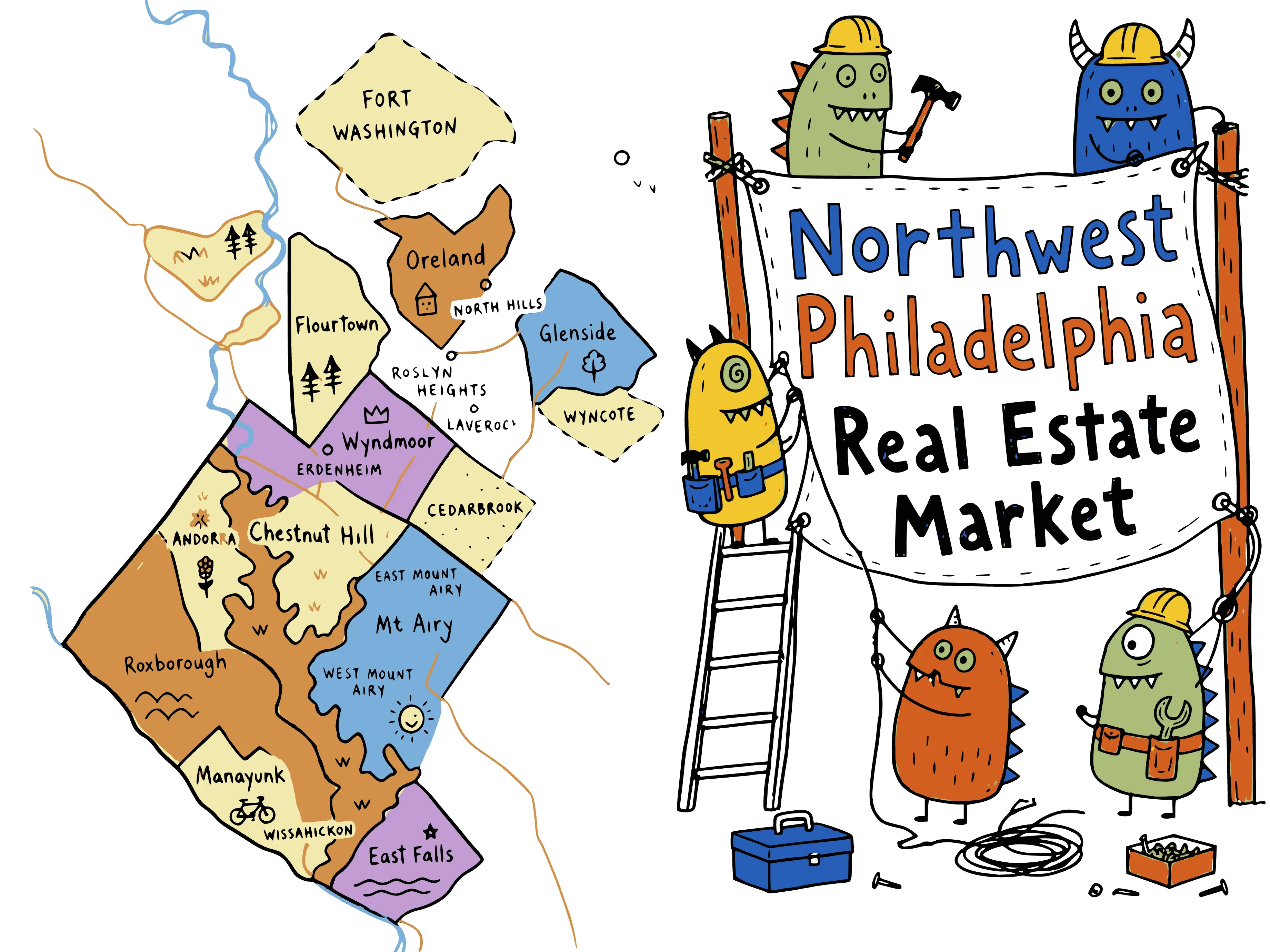
Glenside spans portions of Cheltenham and Abington townships in Montgomery County. It has a SEPTA regional rail station on the Lansdale/Doylestown line, a commercial corridor on Easton Road, and the Keswick Theatre, which has been operating since 1926. The housing stock was built primarily between the 1920s and 1950s.
Buyers here tend to find prices more accessible than in neighboring Jenkintown or Elkins Park, with a housing stock that has real character: bungalows, stone twins, and Colonial-style homes from the interwar and postwar periods.
Talk to Henry| Median sale price (Sep 2026) | $437,500 |
|---|---|
| Typical price range | $348,500–$570,000 |
| Median days on market | 13 days |
| Zip code | 19038 |
| Township | Cheltenham & Abington Townships, Montgomery County |
Based on information from Bright MLS for 9/1/2026 through 9/30/2026; data is reliable but not guaranteed.
Boundary and reference data from OpenStreetMap contributors, available under the ODbL.
The Keswick Theatre has been a community fixture since 1926, hosting touring acts and local productions across multiple eras of the neighborhood’s history. Easton Road has developed a solid mix of restaurants, shops, and services that give the area a walkable commercial center with staying power.
The housing stock in Glenside is varied and interesting. Bungalows from the 1920s and 1930s with original porch details, stone twins with good bones, and larger Colonial-style homes that have been well-maintained. The variety means there’s generally something in the market for buyers at different price points.
Glenside station provides direct service to Center City Philadelphia on the Lansdale and Doylestown lines, with a trip of roughly 30 to 40 minutes. That access has made the neighborhood consistently attractive to commuters and has had a steady effect on demand over time.
Glenside closed 22 sales in September at a median of $437,500, up from August’s $427,500. Prices ran from $165,000 to $875,000, with the middle half of sales between $348,500 and $570,000. With 22 closings behind it, this median carries more weight than any single month in the smaller Montgomery County towns.
The median time on market rose to 13 days in September from six in August. Six of the 22 sales went under agreement within a week, down from 13 a month earlier, and 10 closed above their original asking prices. The slowest sale took 64 days.
Glenside matched August’s 22 closings while the pace eased. Eleven of the 22 sales closed below their original asking prices, against 10 above and one at it. Glenside is still where the volume is, with more September closings than the other three Montgomery County towns on this site put together.
Based on information from Bright MLS for 9/1/2026 through 9/30/2026; data is reliable but not guaranteed.
The T3 Home Demand Index (HDI) measures buyer urgency relative to available supply, scored against each market’s 2019 activity. Bright MLS reads below 70 as limited demand; 70–89 slow; 90–109 steady; 110–129 moderate; 130 and above high. Updated monthly.
The Philadelphia metro HDI fell to 77 in September 2026, down five points from August and still in the Slow tier. It sits two points below its September 2025 reading of 79. All six segments lost ground on the month. Luxury single-family homes dropped 12 points to 60, into the Limited tier, but they remain the only segment above their September 2025 level. Entry-level condos fell 10 points to 97 and stayed Steady. Entry-level single-family demand slipped one point to 76, nine points under where it sat a year ago. T3 attributed the drop to “rate-and-affordability fatigue.” Freddie Mac’s 30-year average passed 7 percent on September 24, and I wrote about why rates rose after the Fed’s September increase.
Source: Bright MLS T3 Home Demand Index · homedemandindex.com · All 33 data points sourced from monthly report pages.
As of September 2026, the median closed price in Glenside was $437,500 across 22 sales, up from August’s $427,500. September prices ran from $165,000 to $875,000, with the middle half between $348,500 and $570,000. The neighborhood’s mix of Colonials and stone twins anchors that typical range.
In September 2026, the median time on market in Glenside was 13 days, up from six in August, and 10 of the 22 sales closed above their original asking prices. Six went under agreement within a week. Homes here still sell in about two weeks, though the pace eased from the summer.
Glenside straddles Cheltenham Township and Abington Township in Montgomery County, with smaller portions extending into Springfield Township. Which township a given address sits in depends on the specific street.
Glenside is in zip code 19038, which is shared with Wyndmoor and parts of Flourtown. The community is anchored by the Glenside SEPTA Regional Rail station and the Keswick Theatre on Easton Road.
I live in nearby Mt Airy and work the Glenside market regularly.
I know this market and I’m glad to share what I see in it. If you’re thinking about Glenside, feel free to reach out.