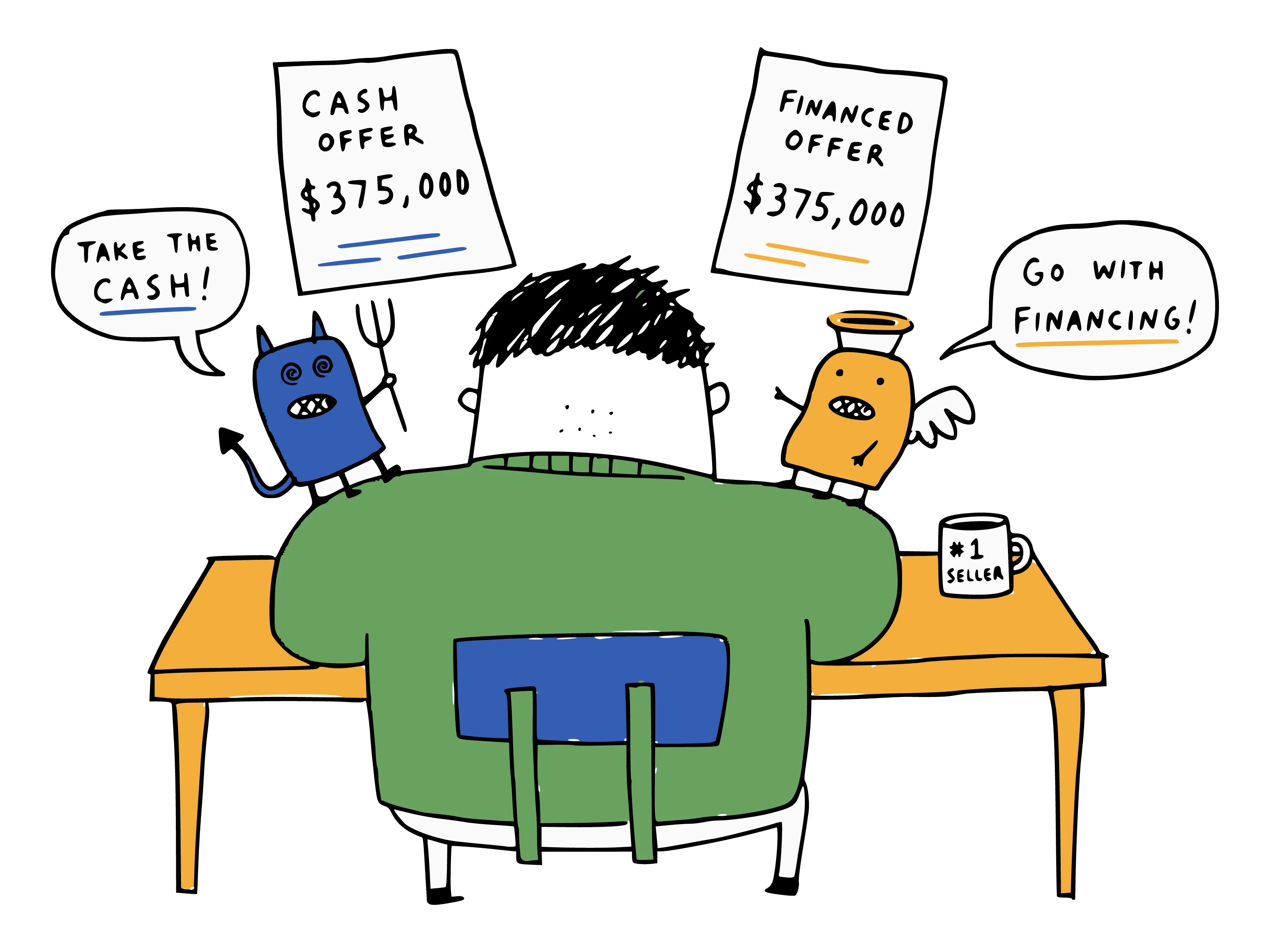

There's a conversation I have with almost every buyer I work with. Sometimes it happens early, just as we're getting started. More often it happens right after the disappointment of losing a house to an all-cash offer. The question is always some version of the same thing: Can we compete with cash? Do we even have a chance?
The short answer is yes. But the longer answer is where it actually gets interesting.
What Makes a Cash Offer "Better"
When a seller sees a cash offer, what they're really seeing is certainty. No lender involved means no appraisal requirement, no underwriting, no last-minute loan denial. One of the most common reasons real estate deals fall apart is mortgage or financing trouble, which accounts for 40% of failed sales according to Zillow. From a seller's perspective, removing that risk is valuable, sometimes worth more than a higher number on paper.
Cash offers also tend to mean faster closings. Without a lender involved, a cash sale can cut out steps like loan underwriting and appraisals, shortening the timeline from weeks to as little as a week.
That's the appeal. It's also where the myth starts.
The Myth: Cash Always Wins
At the settlement table, it's all cash to the seller. Whether the buyer financed their purchase or paid directly from a bank account, the seller walks away with the same check. And in Pennsylvania, there's an important nuance that both buyers and sellers should understand: you can waive your financing contingency and still get a mortgage.
Under the Pennsylvania Association of Realtors standard Agreement of Sale, buyers have three options when it comes to financing:
- Not Applicable: The buyer will not obtain mortgage financing at all.
- Waived: The sale is not contingent on mortgage financing. As the agreement states directly, "the waiver of this contingency does not restrict Buyer's right to obtain mortgage financing for the Property."
- Elected: The sale is contingent upon the buyer obtaining financing according to the terms outlined in the agreement.
Under Option 3, the agreement gives the seller the right to terminate in writing after the commitment date if the buyer hasn't delivered proof of loan approval, if the approval doesn't match the stated loan terms, or if the approval contains unresolved conditions. The agreement also states that the buyer must continue to make a good faith effort to obtain financing until the seller terminates, and that "Termination of this Agreement by Buyer due to the mortgage lender's denial of Buyer's mortgage application(s) may demonstrate bad faith by Buyer and result in the forfeiture of deposit monies to Seller."
That last line is worth reading twice. The deposit protections under Option 3 and the termination rights belong to specific parties under specific conditions, which is exactly why this section of the agreement deserves a close read with your agent before you write an offer.
63% of sellers said that at least one of the offers they received was all cash or did not include a financing contingency, according to Zillow. Those two categories are often treated the same way, because from a seller's perspective the exposure is similar.
And on that note: sellers will often ask for a larger earnest money deposit upfront when a financing contingency is waived. That's not a red flag. The seller is giving up some level of protection when they accept an offer with a waived mortgage contingency, so they want to know you have real skin in the game in addition to verifying that you're actually able to access the cash needed to purchase the property.
The conversation about how best to position yourself in a competitive market, where you may be up against cash offers, should happen with your agent, lender, and any other legal or financial professional you trust before you write anything.
What the Local Numbers Show
I pulled recent closed sales from Bright MLS across the ZIP codes I work in most (the same dataset behind the Q2 2026 market report), and the data pushed back on some of my own assumptions.
In Mt. Airy (19119), cash buyers showed up across the board, from $305,000 all the way up to $875,000. Cash deals happened at the same price points where financed deals happened.
In Roxborough (19128), the split was nearly even: 7 cash closings and 6 conventional. What stood out was that cash deals weren't clustering at the top of the range. The median cash sale in Roxborough was actually slightly below the median conventional sale. Cash buyers there weren't paying more. They were competing differently.
In Manayunk (19127), the sample is small (only three recent closings in the data), but all three financing types appeared: conventional, FHA, and cash. The price spread was wide.
The takeaway: cash is not the exclusive territory of investors or high-end buyers. It shows up at every price point in these neighborhoods, which means the competition is real and worth taking seriously.
The Execution Details: How Financed Offers Actually Win
"Be competitive" is advice. Here's what it looks like mechanically, in the order I'd prioritize it:
1. Upgrade from pre-approved to underwritten. A pre-qualification is a conversation; a pre-approval is a credit pull and document review; a fully underwritten approval means the lender's underwriting team has already vetted your file and the only thing left to clear is the property itself. Many lenders will do this before you're under contract if you ask. To a listing agent, an underwritten buyer has removed most of the financing risk that makes cash attractive in the first place. A one-line letter from the lender saying so belongs with your offer.
2. Tighten the dates. The PA Agreement of Sale has a mortgage commitment date the seller watches like a clock. If your lender can commit in 21 days, don't write 45 because it's the default. The same goes for settlement: a financed offer that closes in 30 days against a cash offer closing in 14 is a much smaller gap than the stereotype suggests.
3. Address the appraisal head-on. The appraisal is the piece of financing risk a seller can't see past, especially if your offer escalated above list. Appraisal gap coverage (committing in writing to bring a defined amount of extra cash if the appraisal comes in low) caps the seller's downside without you waiving the protection entirely. The key word is defined: cap it at a number you can actually wire, not a number that wins the house and breaks you.
4. Size the deposit like you mean it. Earnest money in this market often runs light relative to what it signals. Moving from 2% to 5% costs you nothing if you close (it's all credited at settlement) and tells the seller you don't intend to walk.
5. Give them the calendar. Many sellers in Mt. Airy and Chestnut Hill are selling a long-held family home and buying their next one simultaneously. A rent-back option or a flexible settlement date can beat $10,000 of price. It's the cheapest concession you'll ever make, and buyers almost never think to offer it unprompted.
None of these requires waiving anything. That's the point: most financed buyers lose to cash on perceived risk, not actual dollars, and perceived risk is something you can manage.
What This Means for You as a Buyer
About half the time, sellers who receive at least one all-cash offer ultimately choose to sell to a mortgage buyer, because price, terms, and relationship all factor in. A financed offer is a different hand, not a losing one.
The most competitive financed buyers I've worked with have three things in common: they're fully pre-approved (not just pre-qualified) before they write anything, they understand the contingencies they're waiving and why, and they have an agent who knows how to frame the offer in a way that builds seller confidence. Inspection contingency choices often come up alongside the financing decision; this plain-English breakdown of how inspections work in a PA transaction covers that side.
If you lost a house to cash recently and you're wondering what's possible on your next offer, let's sit down and actually look at your numbers. That's where the real answer lives. What it takes to compete also changes from one town to the next, which is why I cover Roxborough and Manayunk separately.
I'm a REALTOR®, not a lawyer, and nothing in this post should be taken as legal advice. The financing options and agreement language referenced here come directly from the Pennsylvania Association of Realtors standard Agreement of Sale. Buyers and sellers should consult with their agent and, where appropriate, a licensed Pennsylvania real estate attorney before evaluating their options.
Henry is a Philadelphia-based REALTOR® serving buyers and sellers in Northwest Philadelphia and Montgomery County, PA. Questions? Get in touch.
Based on information from Bright MLS for 4/1/2026 through 6/30/2026; data is reliable but not guaranteed.
Frequently asked questions
Can a financed buyer compete with a cash offer?
Yes. About half the time, sellers who receive at least one all-cash offer ultimately choose a mortgage buyer, because price, terms, and relationship all factor in. The most competitive financed buyers are fully pre-approved, understand which contingencies they're waiving, and have an agent who can build seller confidence around the offer.
What does it mean to waive a financing contingency in Pennsylvania?
Under the Pennsylvania Association of Realtors standard Agreement of Sale, waiving the financing contingency means the sale is not contingent on mortgage financing, but the buyer can still obtain a mortgage. It removes the seller's right to terminate if the buyer fails to deliver proof of loan approval, shifting risk to the buyer. Sellers typically ask for a larger earnest money deposit in exchange.
How can a financed buyer make their offer more competitive against cash?
The strongest levers, in rough order: get a fully underwritten pre-approval (not just a pre-qualification) so your financing risk is already vetted; offer a shorter mortgage commitment date so the seller isn't waiting six weeks to know the deal is solid; consider appraisal gap coverage with a cap you can actually fund; increase your earnest money deposit; and offer settlement-date flexibility, which costs you nothing but can matter enormously to a seller coordinating their own move.
Are cash offers common in Northwest Philadelphia neighborhoods like Mt. Airy, Roxborough, and Manayunk?
Yes. Cash offers appear at every price point across Mt. Airy (19119), Roxborough (19128), and Manayunk (19127), not only at the luxury end. In Roxborough, the split between cash and conventional closings is nearly even, and cash buyers weren't clustering at the top of the price range.