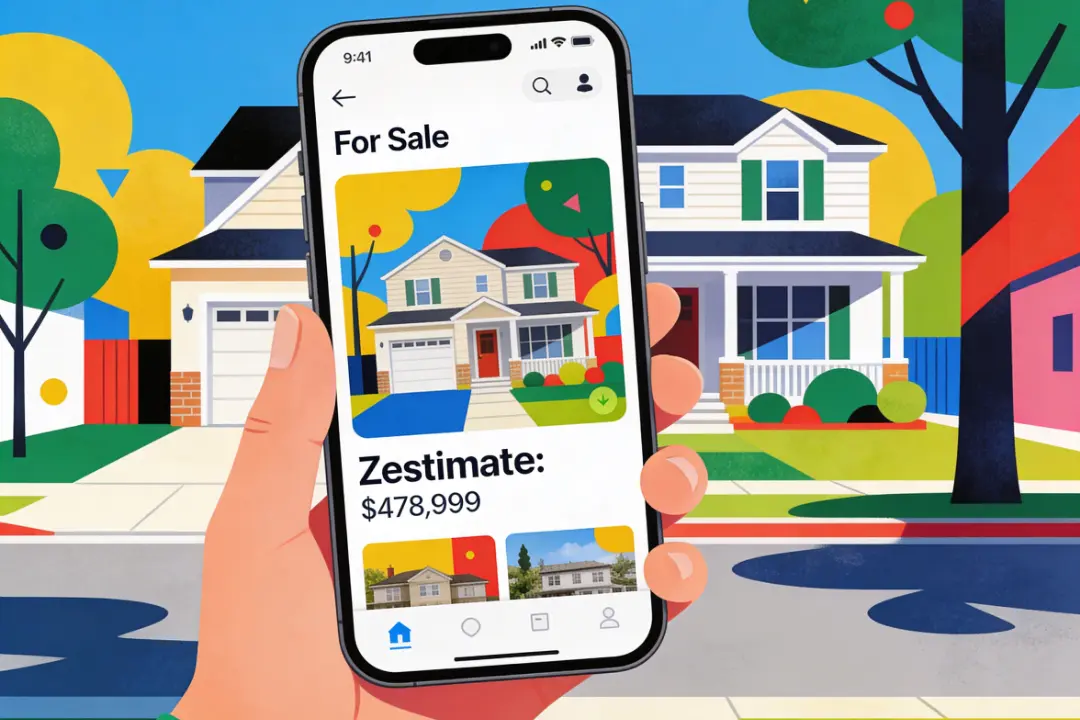
Nearly all of them, but not quite all. A home listed with an agent and entered into the MLS almost always reaches Zillow within a day. The ones you will not find there are the homes that never enter the MLS, or have not entered it yet.
Listings can also surface at different times on different sites. Whether a specific home is visible comes down to how it is marketed and which rules govern where its data is allowed to travel.
How a standard listing reaches Zillow
When an agent takes a listing under an exclusive agreement with a seller, they typically enter it into the MLS. The MLS, or multiple listing service, is the regional database that agents use to share listings and cooperate on sales. In the Philadelphia region, that database is Bright MLS.
The MLS distributes listings out to consumer websites through data feeds, a process called syndication. Two feed types do most of the work. IDX (Internet Data Exchange) powers the public listing search you see on portals and brokerage sites. VOW (Virtual Office Website) is a registered-user version that can display additional detail. Zillow, Realtor.com, Redfin, Homes.com and thousands of agent sites all pull from these feeds.
So for a normal, publicly marketed home that gets entered into the MLS, this is why it lands on Zillow and everywhere else at roughly the same time. For standard listings, the answer is yes.
The listings you might not see
The gap opens up with homes that are not entered into the MLS, or not entered right away.
- Off-market, private, or "pocket" listings. A home marketed quietly, sometimes only within one brokerage's own network or to a small list of buyers, without ever being placed in the MLS. If it never enters the MLS feeds, it generally will not appear on Zillow. High-profile properties are often kept private this way, for the seller's privacy or other personal reasons.
- "Office exclusive" listings. A home kept inside a single brokerage before, or instead of, going to the MLS.
- "Coming soon" or pre-market listings. A home advertised as coming soon before it is formally listed. Depending on timing and where it is advertised, it can appear on one site before another, or not on the major portals yet at all.
- For sale by owner. Homes sold without an agent generally are not in the MLS. Owners can, however, post them directly on Zillow, which is how many for-sale-by-owner homes end up there.
- New construction. Builders often do list on Zillow, but not always. Some market only on their own website, and others post just a couple of homes and invite buyers to contact them for the rest.
- Seller opt-outs. A seller can ask to keep a home in the MLS but off public internet display.
There are many cases where a home can be listed for sale without being listed on Zillow. Whether keeping a home off the portals costs a seller more than it gains is a fair question, and the answer turns on how much of the buyer pool starts there.
Where broker and MLS policies come in
Whether a given listing shows up on a given site is governed by several sets of rules layered on top of each other.
MLSs set the terms of their own feeds, and they can enforce them. The clearest test of that has been in Chicago. In late 2025, the large Chicago-area MLS clarified that websites using its feed could filter listings only by objective criteria such as geography, price, property type and listing type, not by how a brokerage chose to market the home. Then, in the spring of 2026, that same MLS briefly cut off Zillow's feeds, temporarily pulling roughly 43,000 listings from Zillow and Trulia until a judge ordered them restored. HousingWire has been tracking that fight in detail, and their timeline of Zillow's listing war with MRED is worth a read. That is one market and one example of a broader fight. It does not change what a buyer or seller sees here in the Philadelphia area, but it shows how much can hinge on rules most people never notice.
Portals set their own display policies too. Zillow adopted a set of listing access standards in 2025 that block a publicly marketed home from its site if it is not made available through the MLS feeds within one business day of that marketing.
And there are industry-wide rules. The National Association of Realtors' Clear Cooperation Policy requires a listing to be submitted to the MLS within one business day of any public marketing.
The practical result is that the same home can be visible on one site and missing from another, based on how it was marketed and whose rules apply.
The power of the portals
Zillow, founded by Rich Barton and Lloyd Frink, was incorporated in December 2004 and launched its public website in February 2006. For most of the 20 years since, it has been the default first stop for buyers. That position was built largely on listings and lead generation, the advertising business behind the "Contact Agent" button. (I wrote about how that button actually works in this post.) That reach is exactly why the question of what does and does not appear on a portal carries weight.
That position may not hold. Brokerages have long relied on the MLS to handle distribution of their listings. Some are now weighing whether there is an advantage to owning and controlling their own listing data instead. If that shift accelerates, listing availability could become less consistent from one site to the next, with some homes appearing first, or only, where a brokerage decides to send them.
What this means in Northwest Philadelphia
For Mt. Airy, Chestnut Hill and the rest of Northwest Philadelphia and Montgomery County, standard listings entered into Bright MLS still flow out to Zillow and the other major sites. Most homes for sale here are visible on Zillow. The exceptions are the ones above: privately marketed or off-market homes, pre-market listings that have not fully syndicated yet and anything a brokerage is holding inside its own network.
The most reliable way to see everything for sale, including homes that have not reached the portals, is to work with an agent who has direct MLS access and can search the source rather than a downstream copy of it.
If you are searching here and want to know what is not on the portals, call me at 484-571-4577 and I will run the Bright MLS search with you. If your search has narrowed to one town, there is more on Mt Airy and Chestnut Hill.
Henry is a Philadelphia-based REALTOR® serving buyers and sellers in Northwest Philadelphia and Montgomery County, PA. Questions? Get in touch.
Frequently asked questions
Are all homes for sale listed on Zillow?
Not all of them. Most standard listings entered into the MLS are syndicated to Zillow, so the majority of homes for sale in a given area appear there. But off-market, private and 'office exclusive' listings that are never placed in the MLS generally do not, and 'coming soon' or pre-market homes may appear on some sites before others.
Why isn't a home I know is for sale showing up on Zillow?
Common reasons include: it is being marketed privately or within a single brokerage rather than through the MLS, it is in a 'coming soon' phase and has not fully syndicated yet, it is new construction the builder has chosen not to post or the seller opted out of public internet display. Feed disputes between an MLS and a portal can also temporarily remove listings from a site.
What is the difference between the MLS and Zillow?
The MLS (multiple listing service) is the professional database agents use to share listings and cooperate on sales. In the Philadelphia region, that is Bright MLS. Zillow is a consumer-facing portal that displays many of those listings through data feeds. The MLS is the source, and the portal is a downstream copy that does not always contain everything the MLS does.
What are IDX and VOW feeds?
They are the two main ways an MLS sends its listings to websites. IDX (Internet Data Exchange) powers the public listing search on portals and brokerage sites. VOW (Virtual Office Website) is a registered-user version that can show additional information. MLS rules govern what each feed is allowed to display and filter.