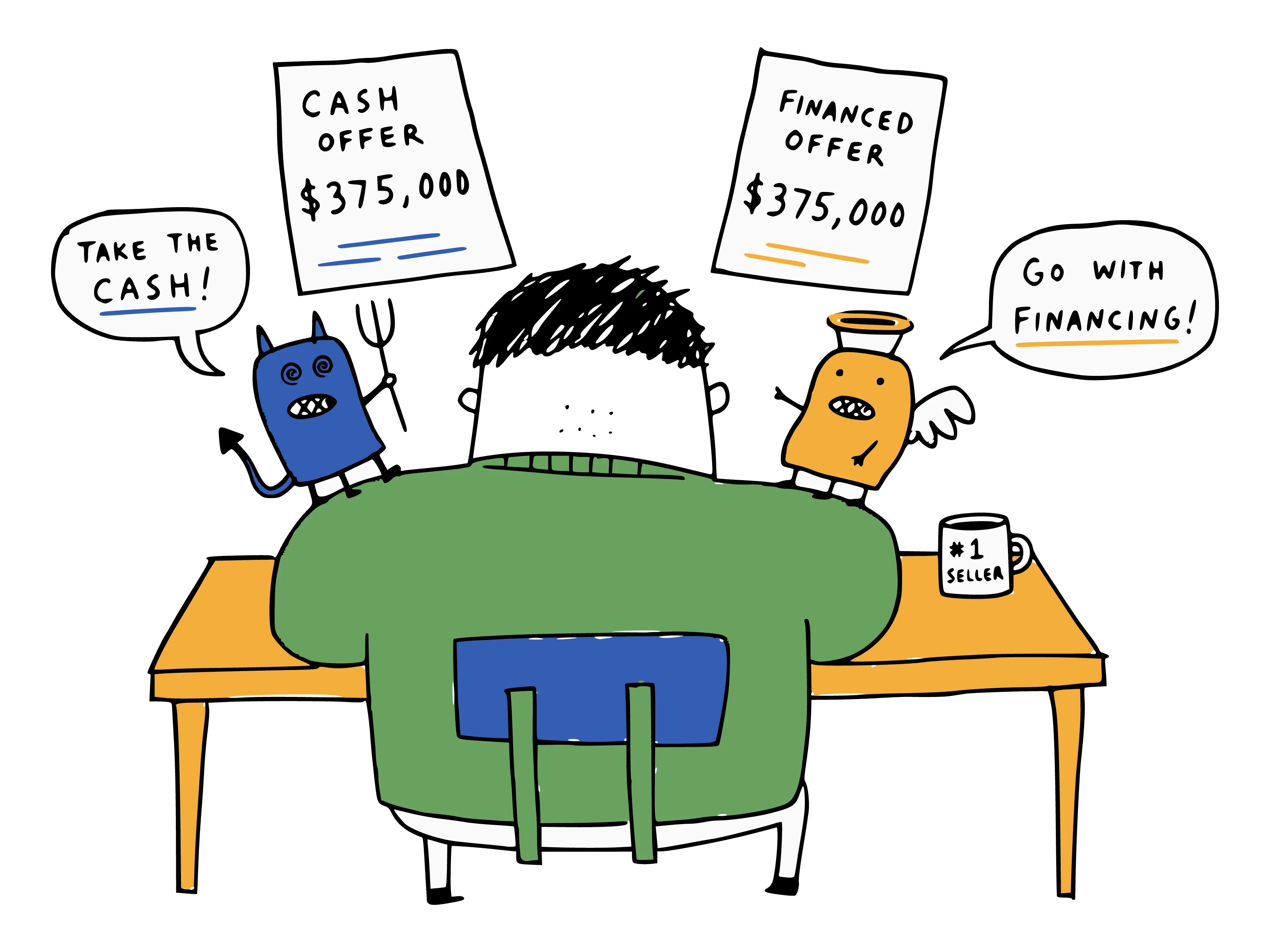
Picture two offers on your kitchen table. The price is the same, the settlement timeline is roughly the same and the inspection terms match. The only real difference is that one buyer is financing and one is paying cash. Most sellers assume the cash offer is the better one. Often it is, but the reason is narrower than people think, and the gap between the two is usually smaller than it looks.
I wrote about this from the buyer's side in cash vs. financed offers. Here is the same question answered from the seller's side of the table.
What the bank adds to the deal
A financed offer brings a third party into your transaction. The lender has its own timeline, its own underwriting standards and its own opinion about what your house is worth. None of that is under your control or your buyer's.
That is the whole of the cash advantage, and it is not about the money: at settlement the funds are the same either way, and your check does not know how the buyer got there. Cash removes the chance that someone outside the contract says no.
Financing trouble is one of the leading reasons deals fall apart; Zillow has put it at roughly 40 percent of failed sales. That risk is real, but it is a risk you can size up rather than guess at.
The appraisal, especially over list price
This is the piece that catches sellers most often.
A lender will only lend against the appraised value, not the contract price. If your home is under contract above list and the appraisal comes in below that number, the buyer generally has three paths:
- Cover the difference in cash
- Come back to you and try to renegotiate the price
- Terminate, if they elected an appraisal or financing contingency that gives them that right
A cash buyer has no lender imposing that requirement. They can still order an appraisal, and the sale can still be made contingent on one if that was negotiated into the contract up front, so a cash offer is not automatically free of appraisal risk. Read the terms rather than assuming. But strictly from a funding perspective, if the buyer has the money, the appraised value does not necessarily affect their ability to complete the purchase.
So if you took a financed offer above list, the question to ask before you sign is whether the offer includes appraisal gap coverage, and whether that coverage is written as a defined dollar amount. "Buyer will cover any gap" is a sentence. "Buyer will bring up to $15,000 above appraised value" is a commitment you can evaluate.
Speed, and whether it helps you
Cash can close quickly, sometimes in a week or two, because the underwriting and appraisal steps come out of the timeline. A financed purchase in Pennsylvania more commonly runs 30 to 45 days.
Whether that is worth anything depends entirely on your situation. If you are settling an estate or carrying two mortgages, a fast close has real value. If you are buying your next house and need time to coordinate, a fast close is a problem, not a benefit. Speed is only an advantage when it matches your calendar.
Cash also does not remove every step. Title work still has to be completed. The title company runs a search, and anything it turns up has to be cleared before transfer: an old lien, a judgment, an open mortgage that was paid but never satisfied of record, an estate that was never properly settled. Payoff letters take the time they take. On top of that, many municipalities in Montgomery County require a resale or use and occupancy certificate before a property can transfer, which means scheduling a township inspection and correcting whatever it flags.
None of that goes away because the buyer is paying cash. Ask your agent what your township requires and how the title search looks before you count on a two-week settlement.
Proof of funds is only as good as you verify it
A cash offer is a claim until it is documented. Ask your REALTOR® to look at the proof of funds carefully:
- Is it dated within the last 30 days or so, and does the balance cover the purchase plus closing costs?
- Is the account in the buyer's name?
- Are the funds liquid, or are they sitting in a retirement account, a brokerage account or the proceeds of a home the buyer has not sold yet?
Cash that depends on another sale closing first is not the same as cash in a checking account, and it is fair to ask.
Your proceeds will likely arrive by wire at settlement, so sellers are wire fraud targets too.
Look at the financed offer's actual terms
Two financed offers can carry very different amounts of risk. A buyer with a fully underwritten approval, a 21-day mortgage commitment date and a 5 percent deposit is a meaningfully different proposition than a buyer with a pre-qualification letter, a 45-day commitment date and 1 percent down in escrow. Under the Pennsylvania Agreement of Sale, a buyer can also waive the financing contingency entirely and still get a mortgage, which changes your exposure again.
If the financed offer in front of you is strong on all of those points, the certainty gap between it and the cash offer narrows considerably.
So which one do you take?
If the two offers are identical in every term and one is cash, cash is usually the cleaner path. That is a fair instinct.
The point is that they are almost never identical, and price is only one of the places they differ. Deposit size, commitment dates, appraisal protection, proof of funds and settlement flexibility all belong in the comparison. Sit down with your agent and go through the offers line by line before deciding which one is really stronger.
If you are listing in Mt. Airy, Chestnut Hill, Roxborough or anywhere else in Northwest Philadelphia and you want a second set of eyes on the offers you are weighing, reach out. Comparing them properly takes about 20 minutes and it is worth every one of them. Sellers in Wyndmoor and Glenside can read how I run a sale there.
I am a REALTOR®, not an attorney. This is general information, not advice about your transaction. Before you accept or counter anything, review the offers with a qualified real estate agent and, where the situation calls for it, a licensed Pennsylvania real estate attorney.
Henry is a Philadelphia-based REALTOR® serving buyers and sellers in Northwest Philadelphia and Montgomery County, PA. Questions? Get in touch.
Frequently asked questions
Is a cash offer always better for a seller?
No. At settlement the money is the same either way. A cash offer removes lender risk: underwriting, the appraisal requirement and the financing timeline. A financed offer with a fully underwritten approval, a tight commitment date, a healthy deposit and defined appraisal gap coverage can be nearly as certain, so compare the terms line by line rather than deciding on the label.
What should a seller check on a proof of funds letter?
That it is recent, ideally dated within the last 30 days; that the account is in the buyer's name; that the balance covers the purchase price plus closing costs; and that the funds are liquid rather than sitting in a retirement account or tied up in a home the buyer still has to sell. Cash that depends on another sale closing first is not the same as cash in a checking account.
What happens if the appraisal comes in low on a financed deal?
The lender will only lend against the appraised value, so the buyer has to cover the difference in cash, renegotiate the price or terminate if a contingency gives them that right. Sellers weighing an above-list financed offer should ask for appraisal gap coverage written as a defined dollar amount rather than a vague promise to cover any gap.
How fast can a cash sale close in Pennsylvania?
Sometimes in a week or two, since underwriting and the appraisal drop out of the timeline. Title search, payoff letters and, in many Montgomery County municipalities, a township resale or use and occupancy inspection still take time, so ask what applies to your property before counting on a very fast settlement. A financed purchase more commonly runs 30 to 45 days.