
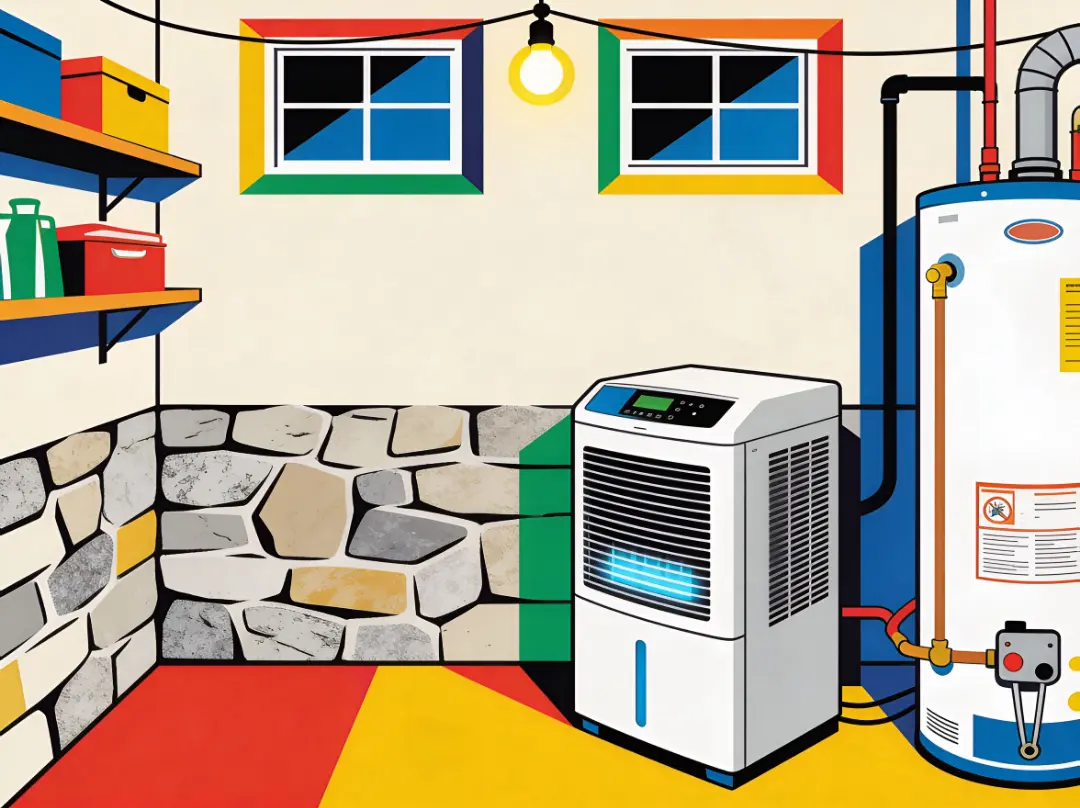
Walk into the basement of almost any house built before 1940 in Mt. Airy or Chestnut Hill and there's a dehumidifier running in the corner, with a hose across the floor or a bucket somebody empties every few days. I see one in most of the basements I show, and it's rarely a red flag. Stone and early block foundations are porous, the air here is humid for most of the summer and the appliance is how the owner keeps up with both.
Why old basements get humid
Most of the houses I show in Mt. Airy, Chestnut Hill, Germantown and the nearby Montgomery County towns were built between the late 1800s and the 1940s, on foundations of stone or early concrete block. Both materials are porous. Water in the surrounding soil moves through them all the time, sometimes as a visible trickle, more often by capillary draw through the masonry or as vapor through the wall itself (which is why a wall can be damp with no puddle under it).
Then summer arrives. Warm, humid air drifts in through the windows and the gaps around them and condenses on the cooler walls and floor. The first time you put a hand on a wall like that, the reaction is "this basement leaks." In July, a lot of the time, it's condensation.
What a dehumidifier does, and what it can't
A dehumidifier pulls water out of the air. The basement feels drier, the musty smell fades and for most owners that's the whole point of it.
The water in the wall is a different problem. Research from the University of Minnesota Extension makes the point plainly: dehumidification manages the symptom while the source continues. If moisture is pushing through the foundation, a dehumidifier can speed it up, because drier air on the inside pulls more of it through. The air feels fine and the wall keeps doing what it was doing.
As one piece of a moisture plan, though, a dehumidifier is a normal, sensible tool, and it's the piece almost every owner starts with. The piece that stops the water is outside.
The three kinds you'll run into
Portable units are the ones I see in most basements: the plug-in appliance from any home improvement store, with a reservoir you empty or a hose that drains on its own. They're cheap and easy to replace, and they move with you.
Whole-house dehumidifiers tie into the HVAC system and condition the air through the whole house. They cost more up front and ask less of you day to day. They also handle more moisture, more consistently.
If the house has a crawl space instead of a full basement, there's a third kind, the crawl space unit, built to run in tight, low spaces and usually paired with a vapor barrier.
The plan the dehumidifier belongs to
The work that keeps a basement dry happens outside. Grade the soil so it slopes away from the house. Keep the gutters clear and run the downspouts well past the foundation. Put in a sump pump where groundwater is the issue, and where it's worse than that, a French drain or an interior channel along the edge of the slab. The dehumidifier handles whatever is left in the air once the source is under control.
What to ask when you're buying
A dehumidifier in the basement of a house you're touring is worth asking about, and not worth panicking over. Ask whether there's active water coming in, whether the grading and the gutters have been dealt with and whether there's a sump pump and when it last ran. Those three answers tell you more about the basement than the appliance in the corner does.
If you're looking at a specific house and want a second set of eyes on the basement, reach out. Walking through one with you is part of the job. And if the house is in Wyndmoor or Glenside, I work with buyers in both.
Henry is a Philadelphia-based REALTOR® serving buyers and sellers in Northwest Philadelphia and Montgomery County, PA. Questions? Get in touch.
Frequently asked questions
Is a dehumidifier in the basement a red flag when buying an older home?
Usually not. Older Philadelphia-area homes have stone or early concrete block foundations, which are porous, so some moisture movement is the nature of the construction and a dehumidifier is a normal management tool. The more useful questions are whether there's active water intrusion, whether grading and gutters carry water away from the foundation and whether there's a working sump pump where one is needed.
Why do old stone foundation basements get damp?
Stone and early concrete block are porous materials, so moisture from the surrounding soil moves through them constantly, whether by direct flow, capillary draw or vapor diffusion. In summer, warm humid air also drifts into the cooler basement and condenses on walls and floors. What looks like a wet wall is often condensation rather than a leak.
Does a dehumidifier fix basement moisture problems?
No. It manages the symptom, not the source. If moisture is actively pushing through foundation walls, dehumidification alone can even accelerate the inward pull. A real moisture plan starts outside: grading that slopes away from the house, functioning gutters and downspouts, a sump pump where groundwater is an issue, and in more serious cases interior drainage or a French drain. The dehumidifier is the finishing piece, not the fix.